


“Clothing” and “water” are among a host of themes the Bible uses to portray Gospel-related truths, often connecting Old Testament foreshadowing with New Testament fulfillment. But how do we actually recognize when a connection is real—and not just something we’re reading into the text?
I wondered the same thing recently.
As our family was wrapping up a reading from Leviticus, my 12-year-old daughter, Elise, interrupted with excitement.
“I found a Gospel thread!” she announced.
I was amused that she would use our podcast name as if it were an official theological category—and equally curious what Levitical content she could be so excited about.
Leviticus is filled with laws about offerings, skin diseases, and bodily fluids… I was pretty sure those weren’t the kind of topics a 7th grader is eager to talk about.
But then she explained that the “Gospel thread” she had noticed was “palms.” She re-read Leviticus 23:40 to us—the instructions for celebrating Israel’s rescue from Egypt and protection in the wilderness through the Feast of Booths:
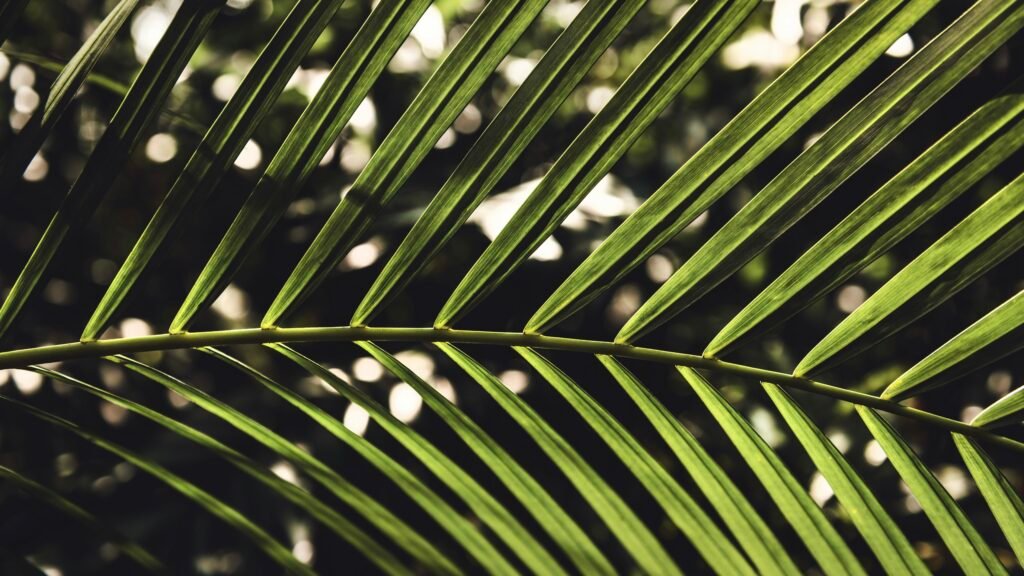
“And you shall take on the first day the fruit of splendid trees, branches of palm trees and boughs of leafy trees and willows of the brook, and you shall rejoice before the Lord your God seven days.”
Could this be a Gospel thread? An Old Testament connection to a New Testament truth?
I knew my daughter was thinking of Palm Sunday—the day that Jesus rode into Jerusalem on a donkey, the crowds waving palm branches like banners. The air filled with expectant shouts for salvation, crying, “Hosanna! Blessed is he who comes in the name of the Lord, even the King of Israel!” (John 12:13).
Both passages are marked by rejoicing. Could it be that palms carries shared meaning between these two passages? And maybe even others?
I had to keep digging.
I opened my Bible app and searched the word “palm.”
There it was again.
1 Kings 6:29, “Around all the walls of the house he carved engraved figures of cherubim and palm trees and open flowers, in the inner and outer rooms.” Turns out palm trees were a prominent feature in Solomon’s temple—God’s royal dwelling place, where sacrifices represented deliverance from sin.
So far, it seemed the biblical authors saw palms as a symbol of flourishing. That idea was confirmed in the next passage: Psalm 92:12, “The righteous shall flourish like the palm tree.”
Righteousness, royalty, redemption, and rejoicing—all beautiful (and even alliterative) expressions of that flourishing.
The next passage I pulled up was Song of Solomon 7:7–8. I’ll let you look that one up yourself. It doesn’t quite fit with the rest of these passages, but you could say palms are used to portray a type of “flourishing” there as well…
Next was Ezekiel 40 and 41. This takes place after Solomon’s temple had been destroyed by King Nebuchadnezzar. The prophet has a vision of a heavenly temple, even more grand than the first one. Here once again, palm trees are carved into this majestic structure representing God’s dwelling place.
And then I came across a passage that brought it all into focus.
I had heard it before, and maybe you have too. It’s the apostle John’s vision of all the saints worshipping at the throne of Jesus, who has cleansed them by his blood.
Revelation 7:9–10, “After this I looked, and behold, a great multitude that no one could number, from every nation, from all tribes and peoples and languages, standing before the throne and before the Lamb, clothed in white robes, with palm branches in their hands, and crying out with a loud voice, ‘Salvation belongs to our God who sits on the throne, and to the Lamb!’” This one brought me to my knees in awe, tears welling in my eyes.
At the Feast of Booths, the people used palm leaves to build forts, as a reminder of God’s salvation from Egypt and provision in the wilderness. In the temple, palm trees adorned this structure that represented God’s presence and His salvation from sin. At Jesus’ entry into Jerusalem—just days before His crucifixion—crowds surrounded Him, looking to Him for salvation, but oblivious to the sacrifice it would cost Him.
And someday in the New Jerusalem, we will be part of a far bigger crowd, palm branches waving in our hands… not as a plea for salvation, but as praise that we have been saved and sealed by the resurrected and enthroned Lamb of God.
So, is “palm” a “Gospel thread?”
I’d say it’s a small—but glorious—one.
Not because every mention of a palm tree carries deep symbolic meaning, but because, when we trace it carefully through Scripture, we see a pattern the Bible itself is building: rejoicing in God’s salvation, flourishing in His presence, and ultimately celebrating the finished work of the Lamb.
That’s what makes something a true Gospel thread. It’s not just a repeated image—it’s a repeated idea, consistently pointing us to who God is and what He has done and will do to save His people.
And sometimes, if we’re paying attention, even a curious observation from a seventh grader can open our eyes to it.